
When Our Generation Calls for the Shutdown

Two weeks ago Anthropic released Fable 5. By Friday it was offline. Seventy two hours from launch to dead.
The US government invoked national security. Dario Amodei pulled the plug — Anthropic is the most ethical lab in the race, they do what Washington asks. A week later a Tokyo lab released a model claimed to be faster than Fable 5. Google and OpenAI have comparable systems sitting in drawers. In China, the engineering headcount on this kind of work isn’t four hundred. It’s most likely closer to forty thousand.
Prohibition doesn’t work. It didn’t work on alcohol, it didn’t work on drugs, it didn’t work on encryption. It is not going to work here.
But that isn’t really what I want to write about today.
I want to write about who is calling for the shutdown.
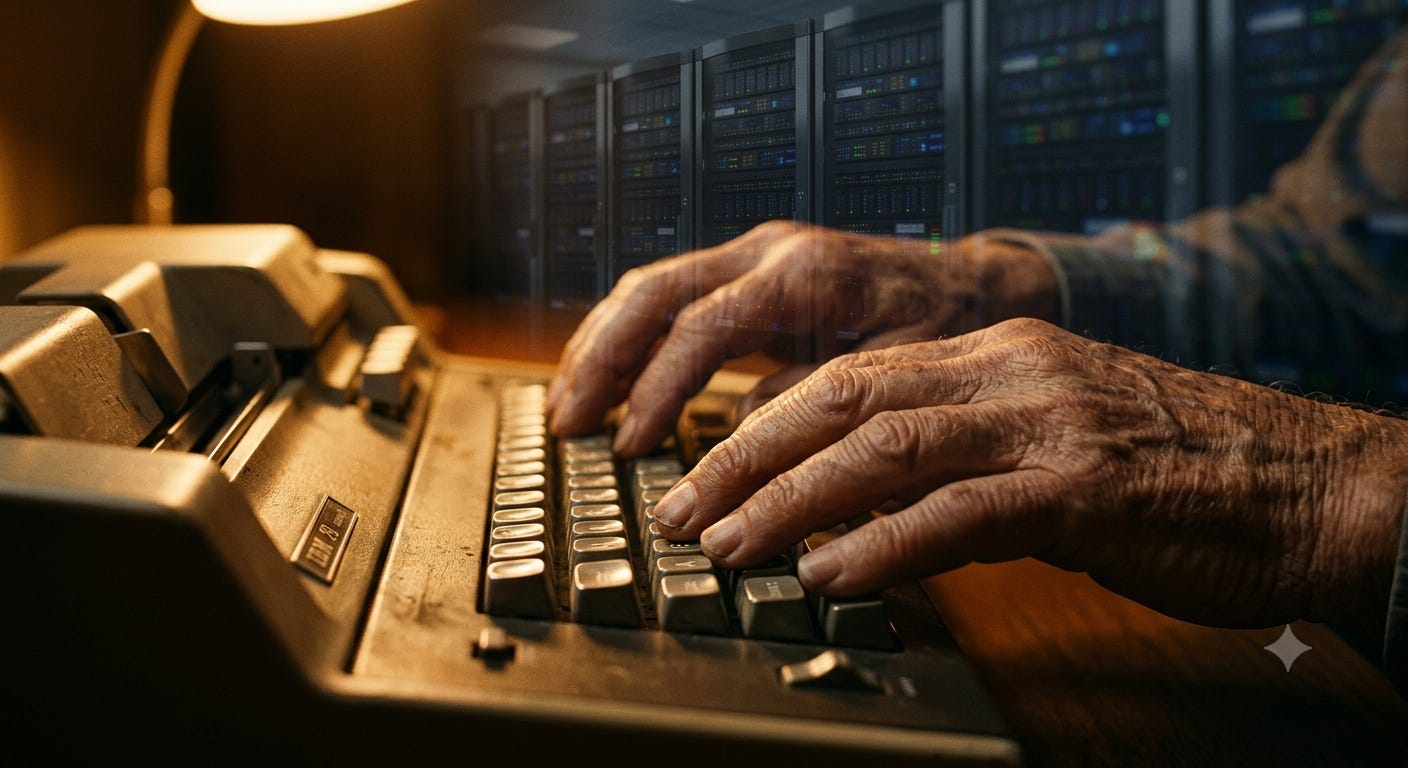
At university I punched holes in cards. I wrote commands on a terminal in the early eighties — three hundred thousand lines of code to calculate something my iPhone now does in two seconds. My first floppy disk was five and a quarter inches across.
In that career, I have lived through every wave of “this new technology will destroy us.” Television will rot the children. Home computers will end every white-collar job. The internet will collapse the social fabric. Mobile phones will end real conversation. AI will take everything that’s left.
Every single one of those panics was led, at some point, by my generation.
And every single time, the panic was wrong about the size of the threat and wrong about the shape of it.
Here is what stings.
The Fable 5 shutdown was not driven by twenty-somethings on TikTok. It was driven by a political class that is mostly Boomer — and supported by a Boomer-heavy electorate that has been told, again, that the new thing is dangerous and should be stopped.
We — my generation — should be the ones in the room saying: “Hold on. I have heard this exact speech four times before. Let’s not do this again.”
Instead we are the ones giving the speech.
The argument for the shutdown was national security. The geometry tells a different story. While Anthropic is paused, Sakana in Tokyo ships something faster. Mistral in Paris keeps releasing. Beijing keeps its forty thousand engineers running around the clock. You don’t stop a race by benching one runner. You just lose that runner’s lap.
If the United States — with Anthropic, OpenAI, Google, Meta, half of Nvidia, half of the world’s compute — can stumble like this, what do we expect to happen in Europe?
We have Arthur Mensch and Mistral. One lab. One bet.
We have the AI Act, which regulates what we are allowed to do with models other people build. It does not build any. While Brussels writes compliance checklists, Washington, Beijing and Tokyo decide which models we are even permitted to use next year.
Digital sovereignty is not a Sunday-speech phrase. It is the question of whether, in five years, we still get to choose the tools we work with — or whether someone else chooses for us.
We are not choosing right now.
I run a project called Silverstreamer for people my age who want to engage with AI rather than fear it. I do it because I have noticed something specific.
The 60+ people I work with are not slow. They are not confused. They often learn faster than the twenty-somethings I used to train at IBM in the nineties, because they bring forty years of pattern recognition to every new tool. They have seen this kind of moment before.
What they often lack is permission. Permission from their peers. Permission from their politicians. Permission from the media that keeps telling them this is dangerous and they should stay away.
When the political class that looks like them and sounds like them shuts down Fable 5 in twenty-four hours, that signal travels. It tells every 65-year-old in Düsseldorf, Lyon and Manchester: stay out of this. It is not for you. It is too risky.
That is the part that costs us a decade.
I am not asking my generation to love AI. I am asking it to remember.
Remember the television panic. Remember the home computer panic. Remember the internet panic. Remember being the kid who was told the new thing would ruin everything, and then watching it not ruin everything.
We are not the audience this time. We are the ones holding the off-switch.