
May Almost Broke Me.
Here's What 34 Videos in 31 Days Actually Look Like.

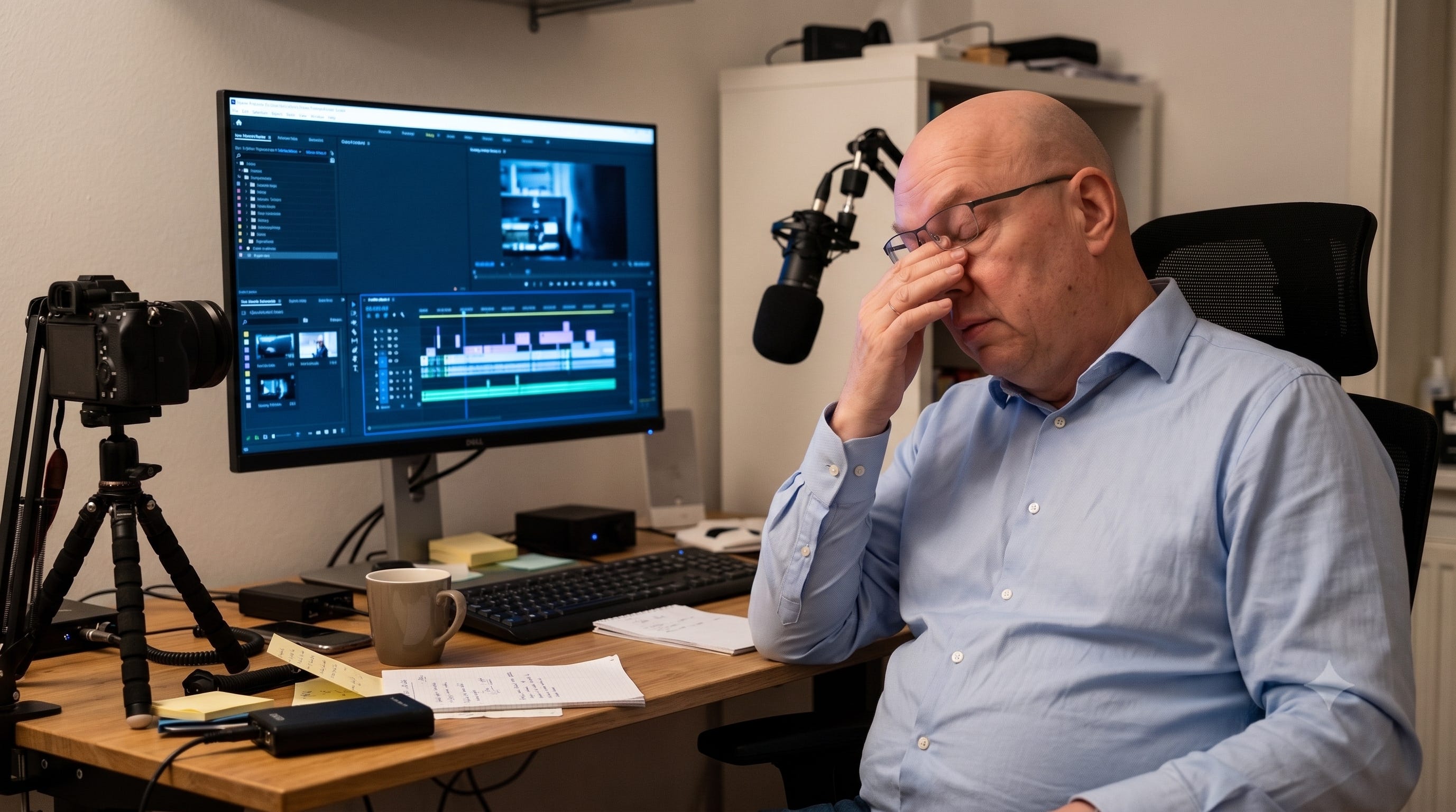
I turned 62 last September. And for some reason I thought the right response to that was to publish 34 videos in a single month.
Let me back up a little. In late April I came back from TubeFest in Birmingham, a YouTube creator conference where I heard a number that stuck with me: the 55-plus demographic is the fastest-growing segment on social media right now. Not Gen Z. Not millennials. Us. The people who supposedly can’t figure out how to unmute themselves on Zoom.
I wanted to test that on my own channel. Not with a strategy deck, not with a content calendar designed by someone half my age. I wanted to know what happens when a 62-year-old goes all in on YouTube for an entire month, alone, without a team.
So I set myself the challenge to publish one video a day for the month of May. At the end it has become 34 videos, 8 livestreams, 24 Shorts, 3 podcast episodes. May 1 through May 31.
On May 1, my channel had 8 views that day. Eight. I stared at that number for a while.
The first ten days were fine. Manageable. I had a rhythm, more or less. Record late afternoon, upload in the evening. But here’s the thing nobody warns you about when you work alone: the editing could take twice as long as the actual shoot. A thirty-minute video could end in at least two hours of post-production. Cutting, SEO, upload, description, tags, thumbnail. Every single time. And there’s no one to hand it off to. But with my experience I’ve collected with Ecamm - my video production software - all that post-production minimal. With a little help of “Y.T.” - my AI assistant - titels, video descriptions, thumbnails, hashtags and tags are done in 15 minutes.
By day ten I was sitting at my desk on Mother’s Day, producing my tenth video while everybody else was buying flowers or calling their mothers. There was no dramatic moment of collapse, no tears, nothing like that. Just a slow, creeping exhaustion that had settled in without me noticing. I looked at my screen and thought: I’m not sure I can keep doing this at this pace.
That was the first honest thought I’d had in ten days.
Around the same time, I ran my channel through a YouTube analyzer I had built for myself. I figured I’d check the data, see where things stood. What I saw was almost entirely red. Click-through rate too low. Watch time too short. Titles not strong enough. I had worked for two weeks straight and my own tool was telling me I was doing most of it wrong.
That’s a strange feeling. Uncomfortable on one hand. On the other hand, it was the first moment of real clarity I’d had since the challenge started.
So I changed direction in the middle of the month. The idea for the livestream experiment didn’t come from a plan or a strategy session. It came from a simple challenge from SPI cohosted by Ecamm: And it told me what would happen if I stop trying to make everything perfect and just talk? Seven consecutive days of going live. No script, no tidy background. Just me and a browser tab with the analytics open.
I want to be careful here, because I don’t want to sell this as some kind of breakthrough story. The numbers did change. On May 27, the channel hit 1,046 views in a single day. That’s not a lot by most YouTube standards. But for a channel that started the month at 8 daily views, it felt like something shifted. Whether it’s sustainable or just a spike, I honestly don’t know yet.
What actually matters to me about this month isn’t the view count. It’s the things that happened between the numbers. I learned to produce faster. The livestream format stopped scaring me somewhere around day four. I started recognizing patterns in what people responded to and what they scrolled past. I got more comfortable being unpolished on camera, which sounds like a small thing until you’ve spent 35 years in corporate environments where everything had to be presentation-ready.
There’s a moment from the second week that I keep coming back to. I was recording a video about AI tools for content creators and I stumbled over a sentence, badly. In the past I would have stopped, gone back, re-recorded the take. This time I just kept going. And when I checked the analytics later, that video had better retention than the ones I had carefully scripted and edited. People stayed longer when the person on screen was visibly human.
I don’t know what to do with that insight yet. I’m still processing it.
Here’s what I do know. This month cost me something. Sleep, mostly. Some social life. A few evenings with my wife that I traded for rendering times. And a certain idea I had about myself, which was that I could do everything alone if I just worked hard enough. Thirty-one days showed me that working harder is not the same as working in a way that lasts.
The 55-plus creator economy is real. The numbers back it up, the audience is there, and the tools are better than they’ve ever been. But nobody talks about the physical and mental cost of producing content at volume when you’re doing it solo in your sixties. The energy isn’t infinite. The enthusiasm carries you for a while, and then you need something more solid underneath.
I’m going to do June differently. Not less, but differently. More live, less perfectly cut. More talking, less producing. More showing up as the person I actually am, and less trying to be the creator I think the algorithm wants.
If you’re over 50 and thinking about starting something online, I want you to know two things. First: it works. The audience is there, and they want to hear from people like us. Second: pace yourself. This is not a sprint. And the version of you that stumbles over a sentence on camera is probably more interesting than the version that gets every take right.
I’m still figuring this out. If you’re on a similar path, I’d genuinely like to hear how it’s going for you.....
Oh, and if you have some time, then come to my livestream here on Substack on Sunday, May 31st at 11:45am EST